
In This Article (7 sections)
Why Enugu-Ezike Is Famous for Palm Wine
Across Nigeria, Enugu-Ezike in Igbo-Eze North Local Government Area of Enugu State is widely known for fresh oil palm wine, locally called Nkwu Enu (up-wine) [1].
Why fresh palm wine earns more than palm oil and palm kernel in Enugu-Ezike, how tappers harvest standing trees, and how the trade reaches cities across Nigeria.
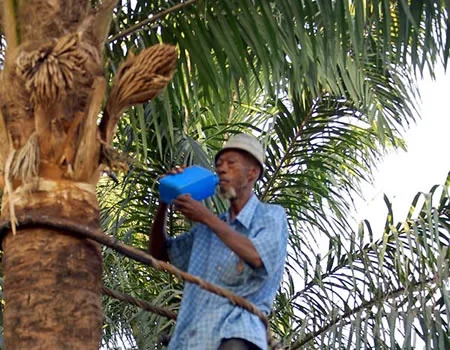
Across Nigeria, Enugu-Ezike in Igbo-Eze North Local Government Area of Enugu State is widely known for fresh oil palm wine, locally called Nkwu Enu (up-wine) [1].
Explore Ogrute, the administrative headquarters of Igbo-Eze North LGA in Enugu-Ezike. Read verified facts on Eke Ozzi Market, St. Mary's Hospital, Enugu-Ezike General Hospital, local schools, parishes, and kindred quarters.
5 min read

Learn how sandy highland soil shapes water supply in Enugu-Ezike, why boreholes need ground surveys before drilling, and what scientists found in local borehole and rainwater tests.
6 min read
In many parts of southeastern Nigeria, people think of palm oil and palm kernels as the main money-makers from the oil palm tree (Elaeis guineensis). However, a university study by historians Apex A. Apeh and Christian C. Opata at the University of Nigeria, Nsukka proved that in Enugu-Ezike, palm wine is the biggest income earner of all [1].
By checking local council produce receipt booklets from 2000 to 2015 across three major markets (Eke Ozzi, Eke Amufie, and Nkwo Aji) alongside interviews and village fieldwork, the researchers found that one year of palm wine income in Enugu-Ezike is higher than six years of income from palm oil, palm kernels, and brooms put together [1].
Enugu-Ezike sits on well-drained sandy loam land with slightly acidic soil that helps wild oil palm trees grow naturally and strongly [1].
Unlike some areas that rely on large company plantations, Enugu-Ezike's palm wine business is run by local smallholder farmers who harvest wild oil palms on family land using traditional skills passed down from older generations [1].
During British colonial rule, farmers in Enugu-Ezike produced palm oil and palm kernels because European trading companies wanted them for export and farmers needed cash to pay colonial taxes [1].
After Nigeria gained independence in 1960, local demand for palm wine grew quickly. Improved road transport made it much easier to carry fresh wine out of Enugu-Ezike every day [1]. Farmers saw that palm wine paid better and gave faster daily cash than processing palm oil or cracking kernels, so many shifted their work to palm wine tapping [1].
As geographer T. C. Mbagwu noted, palm wine became the main good moving daily along the Enugu-Ezike to Nsukka road [1]. From there, traders and drivers move fresh Enugu-Ezike palm wine every day to major cities and bars across Nigeria [1].
There are three known ways to tap an oil palm tree in Igboland, and Enugu-Ezike tappers (Diochi) are very careful about which one they use [1][3]:
Local records from Igogoro also describe a third grade sold in markets called Akuru-Aku, which is a mix of Nkwu Enu and Ekpo (sometimes with water or sugar added) [3]. Buyers who want pure Nkwu Enu in a market often look for the containers surrounded by bees, because bees are drawn to fresh up-wine before anything else [3].
In local custom, the very first tapping from a tree is called ohu esu ala because the tapper does not let the vessel touch the ground before selling it [3]. When fresh wine is poured at a gathering, the thick, sweet bottom pour (ike mmanya) is traditionally given to the eldest person present as a sign of respect [3].
Fresh palm wine is sold every day, with heavy trading across Enugu-Ezike's four-day Igbo market week (Eke, Orie, Afo, and Nkwo) [1][2].
Research studies record active palm wine trading across villages on all four market days, including:
Because demand for Enugu-Ezike palm wine stays strong all year, the business provides steady jobs for tappers, wholesalers, retailers, and road transporters [1].
In interviews with historians, local farmers explained that palm wine income helped families marry, feed their children, pay school fees, build modern houses, and buy motorbikes and vehicles [1]. Apeh and Opata also link steady local income from the palm wine economy to wider community growth: Enugu-Ezike grew from 2 secondary schools in 1976 to 30 public and about 15 private secondary schools by 2015 [1].
Because palm wine ferments quickly in hot weather, clean handling matters for both buyers and sellers [2].
In 2025, scientists from Enugu State University of Science and Technology tested 320 fresh palm wine samples (160 Nkwu Enu and 160 Ekpo) bought across all four market days in Enugu-Ezike [2]. They found that 37 samples (11.56 percent) had bacteria that can produce histamine during fermentation, with higher levels in Ekpo than in Nkwu Enu as the wine sat over one to three days [2].
The researchers recommended washing tapping tools and containers well, keeping containers covered, and handling fresh wine cleanly from the palm tree to the market so Enugu-Ezike's palm wine keeps its strong reputation across Nigeria [2].
The oil palm wine economy of rural farmers in Nigeria: evidence from Enugu Ezike, south-eastern Nigeria (2019)
Apex A. Apeh and Christian C. Opata • Rural History, Vol. 30, No. 2, pp. 111-128 (Cambridge University Press)
View External SourceCharacterization of Multi-Antibiotic Resistant Histamine Producing Escherichia Species Isolated from Palm Wine Tapped from Elaeis guineensis in Enugu Ezike, Nigeria (2025)
Cyril Adonu, P. Onyi, H. Okorie, et al. • Journal of Pure and Applied Microbiology, Vol. 19, No. 3, pp. 2247-2259
View External SourceNjirimara Obodo M: Igogoro, Enugu-Ezike (2016)
Justus Izuchukwu Onuh • Department of Philosophy, Bigard Memorial Seminary, Uwani Enugu
View External SourceDocumented By
Enugu Ezike Editorial Archive
Community historians documenting the villages, traditions, and history of Enugu-Ezike.
Read verified findings from four university studies on farming in the Enugu-Ezike Agricultural Zone, covering major crops, melon production, farm loans, phone and radio access, and climate change.
6 min read