Geography, Water Supply, Boreholes, and Rainwater Harvesting in Enugu-Ezike
Why Enugu-Ezike has few natural streams, how deep groundwater lies under its hills, and what university lab tests show about local borehole water and stored rainwater.
Enugu Ezike Editorial Archive24 November 20266 min read5 Citations
Anyone who knows Enugu-Ezike in Igbo-Eze North Local Government Area of Enugu State knows its hills, dry valleys, and long dry-season water search [1].
Geologists explain that this water shortage comes straight from the rocks and soil underneath the town [1][2]. Enugu-Ezike sits inside the Anambra Sedimentary Basin on the northern highlands of Enugu State [1][2]. Beneath the ground are four main rock layers: the Nkporo Formation, Mamu Formation, Ajali Sandstone, and Nsukka Formation[2].
Two features make natural surface water rare in Enugu-Ezike:
Thick, Loose Sandy Soil: The dominant rock layer across the area is the Ajali Sandstone, topped with red earth and laterite soil [1][2]. Because this sandy soil lets water pass through very easily, rainwater quickly soaks deep underground instead of staying on the surface to form rivers or streams [1][2].
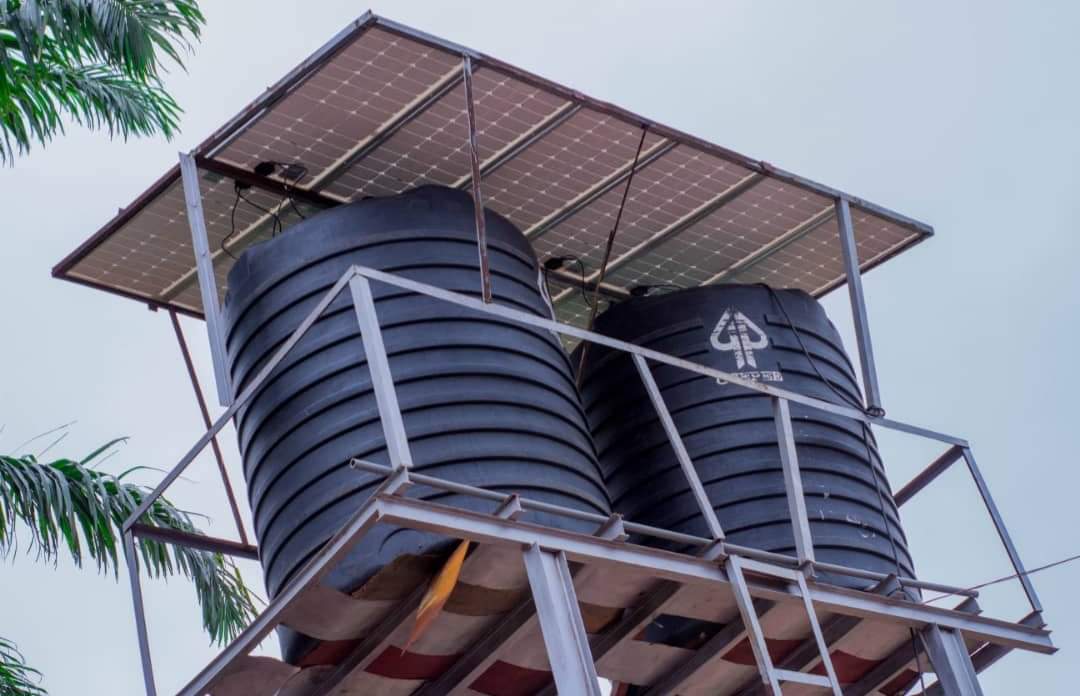
Hills and Dry Valleys: The land is shaped by residual hills and dry valleys [1]. As a result, most communities across Igbo-Eze North depend on deep boreholes and rainwater harvesting rather than streams or rivers [1][4].
How Deep Is Groundwater Under Enugu-Ezike?
Because surface water is scarce, drilling boreholes has become the main source of everyday water across Enugu-Ezike [1][3]. However, drilling without testing the ground first is risky [1].
In 2023, four geophysicists at the University of Nigeria, Nsukka (Mirianrita Ngozi Ossai, Francisca Nneka Okeke, Daniel Nnaemeka Obiora, and Johnson Cletus Ibuot) carried out electrical ground surveys across Enugu North, covering Igbo-Eze North, Igbo-Eze South, Nsukka, and parts of Udenu[1].
They found that:
The ground under the area is made up of 5 to 6 underground layers[1].
The main water-holding rock layer (aquifer) sits deep in the fourth and fifth layers, with 84 percent of productive water zones lying in the fourth layer [1].
The top cover above the water layer ranges from 8.9 meters to 99.5 meters thick, with an average thickness of 54.2 meters[1].
Drilling without a proper electrical survey often leads to dry boreholes, very low water yield, or wasted money [1].
In 2022, a separate team of earth scientists (A. O. Omali, K. G. Ugbena, and S. U. Ezeugwu) carried out 11 underground electrical soundings specifically in Umuida and its surrounding area in Igbo-Eze North [2]. Their study showed that the water table across the wider northern Enugu highland system varies sharply by elevation: it can lie around 106.7 meters deep in upland recharge areas and rise to around 9.15 meters in lower discharge areas [2]. Under Umuida itself, they mapped water-bearing fine-to-medium sandstone layers starting between about 20 meters and 92 meters deep depending on the site [2].
What Lab Tests Show About Borehole Water Quality
Many families in Enugu-Ezike drink borehole water straight from the tap without treatment [3].
In 2018, four chemists at the University of Nigeria, Nsukka (Vitus E. Agbazue, Nwachukwu R. Ekere, Benedict U. Ngang, and Janefrances N. Ihedioha) tested borehole water across Enugu North Senatorial District, including Enugu-Ezike, during both the dry season and the rainy season [3].
They tested for seven metals (cadmium, lead, zinc, iron, copper, sodium, and potassium) and found clear seasonal patterns [3]:
Cadmium and Lead: Neither cadmium nor lead was detected in the tested borehole water samples across both seasons [3].
Zinc: Average zinc levels stayed around 1.3 mg/L in the dry season and 1.4 mg/L in the rainy season, safely below the World Health Organization drinking water limit of 3.00 mg/L[3].
Iron and Copper: Average levels of iron (above the 0.30 mg/L guideline) and copper (above the 1.00 mg/L guideline) were high in both seasons and rose slightly during the rainy season [3].
Why rainy-season levels rose: The scientists explained that slightly acidic groundwater (pH below 6.5) can slowly corrode metal borehole pipes and fittings, allowing more iron and copper to dissolve into the water [3].
Rainwater Harvesting in Enugu-Ezike
For generations, families across Enugu-Ezike have collected roof rainwater in underground concrete tanks and plastic containers to survive the dry season [4][5]. Two university studies tested how clean that stored rainwater really is.
1. Study of 25 Rainwater Storage Tanks in Enugu-Ezike (2019)
In 2019, engineers Chidozie Charles Nnaji and J. P. Nnam at the University of Nigeria, Nsukka collected water from 25 rainwater harvesting tanks in Enugu-Ezike and tested 18 physical and chemical water quality measures [4].
They concluded that stored rainwater can serve families well, but its safety depends heavily on three daily habits [4]:
Keeping roofs, gutters, and storage tanks clean and properly maintained [4].
Choosing safe roofing and tank materials that do not release unwanted chemicals [4].
Disinfecting or treating stored tank water before drinking [4].
2. Study of Roof Runoff Rainwater in Olido Village (2025)
In October 2025, three University of Nigeria chemists (Eno-obong Sunday Nicholas, Calistus Chidebelu Okudo, and Pius Onyeoziri Ukoha) published a study in Scientific Reports comparing urban rainwater in Enugu with rural rainwater in Olido village, Enugu-Ezike[5].
Across 36 rainwater samples, they tested water caught directly from the sky alongside water running off five common roof types used in Nigerian homes [5]:
Long-span aluminum roofs
Stone-coated tile roofs
Asbestos roofs
Corrugated iron roofs
Cameroun zinc roofs
Most samples met national (NSDWQ) and international (WHO and USEPA) water safety standards, with water quality index scores ranging from 3.00 (excellent) to 78.46 (very poor)[5]. However, because some roof coatings and dirt on rooftops can wash into the water, the researchers strongly advised families to filter, boil, or treat harvested rainwater before drinking it[5].
Practical Lessons for Enugu-Ezike Communities
Together, these five field studies point to four practical steps for families, churches, and town unions planning water projects in Enugu-Ezike:
Always run a ground survey before drilling: Paying for an electrical resistivity survey first helps drillers hit the deeper water-holding sandstone layer and avoid dry holes [1][2].
Use non-corrosive borehole pipes: Because slightly acidic groundwater can dissolve iron and copper from metal pipes, durable PVC casings and clean fittings protect water taste and safety [3].
Maintain rainwater gutters and tanks: Cleaning gutters before the first heavy rains and covering storage tanks keeps leaves, dust, and germs out of household water [4].
Treat drinking water: Boiling, filtering, or disinfecting stored rainwater and untreated borehole water gives families safer drinking water all year round [3][4][5].
Geo-electric Sounding for Groundwater Investigation: Case of Umuida and its Environs, Igbo-Eze North Local Government Area, Enugu State, Nigeria (2022)
A. O. Omali, K. G. Ugbena, and S. U. Ezeugwu • Nigerian Research Journal of Engineering and Environmental Sciences (RJEES), Vol. 7, No. 1, pp. 298-308
Metals Contamination of Groundwater Resources of Enugu North District, SouthEast Nigeria (2018)
Vitus E. Agbazue, Nwachukwu R. Ekere, Benedict U. Ngang, and Janefrances N. Ihedioha • Journal of Chemical Health Risks (JCHR), Vol. 8, No. 1, pp. 9-17
Colonial Rule in Enugu-Ezike: Native Courts, the 1935 Intelligence Report, and Leadership Changes
Learn how British colonial rule worked in Enugu-Ezike between 1908 and the 1930s, including the Warrant Chief system, the Native Court, C. K. Meek's 1930 study, and V. K. Johnson's 1935 Intelligence Report.