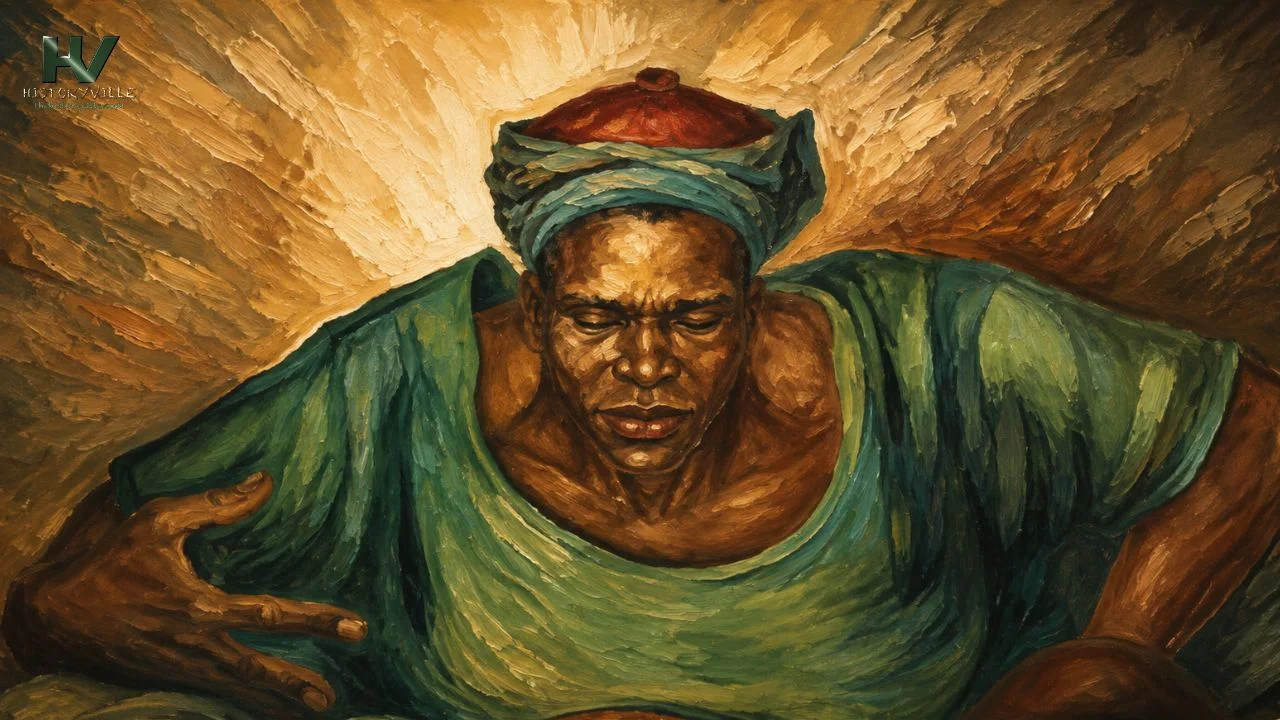
The true story of how a woman from Umuida, Enugu-Ezike became a Warrant Chief in 1918 and was crowned King (Eze) in colonial Nigeria.
Read the full history of the Enugu-Ezike Clergy, Religious, and Aspirants Association (ECRAA), from its founding in 1979 by Very Rev. Fr. Dr. Charles Onuh to its leadership timeline, cultural impact, global mission, and departed members.
5 min read
Read how traditional marriage works in Igogoro, Enugu-Ezike in plain, simple English, from knocking on the door and background checks to Igogoro palm wine, wedding songs, Nkwo market planning, Ndi-ishi rules, and church weddings.
8 min read
She is famous across Nigeria and the world because she was the only woman appointed as a Warrant Chief by the British colonial government in Nigeria, and she was later crowned Eze (King) of Enugu-Ezike [1][2].
Ahebi Ugbabe grew up in Umuida during the late 1800s [1]. When her family faced hard times, they planned to give her in marriage to a local deity to settle a family problem [1][3].
Ahebi refused. As a young woman, she ran away from Umuida and travelled north to Igalaland (around Idah, in today's Kogi State) [1][3].
While living in Igalaland, she worked hard, traded, and learned to speak Igala, Nupe, and Pidgin English [1]. She became wealthy and built strong friendships with the Attah of Igala and with British colonial officers [1][3].
When British colonial officers moved into the Nsukka and Enugu-Ezike area, Ahebi Ugbabe returned home and helped them as a guide and interpreter [1].
Because she could speak both local languages and Pidgin English, and because she understood how the British worked, the colonial government appointed her as a Warrant Chief in October 1918 [1][3]. She sat in the Native Court and helped rule the area [1][4].
In 1937, the British colonial writer C. K. Meek wrote about her in his book Law and Authority in an Igbo Tribe, noting how unusual it was to see a woman holding that office in colonial Nigeria [4].
Ahebi Ugbabe did not stop at being a Warrant Chief. In the early 1920s, with the support of the Attah of Igala, she was crowned Eze (King) of Enugu-Ezike [1][2].
As king, she built a large compound in Umuida, held court, collected tribute, and married wives in the traditional way that wealthy and powerful titled people did in Igboland [1][3].
Even though Ahebi Ugbabe was very powerful, she later clashed with the male elders of Enugu-Ezike [1][3].
In Enugu-Ezike tradition, masquerades belonged strictly to men. Ahebi Ugbabe decided to bring out her own masquerade, called Ekpe Ahebi, to show that she had the same status as male leaders [1][3].
The male elders strongly rejected this and saw it as breaking town custom. They took the matter to the British District Officer. The British officer agreed with the elders and stopped Ahebi from bringing out her masquerade [1][3]. After that, her power in the town began to drop [1].
Ahebi Ugbabe worried that the men of the town might refuse to give her a proper royal burial after she died [1][3].
To make sure she was honoured properly, she held her own living funeral while she was still alive—complete with music, dancing, and full royal rites [1][3].
She died in 1948 in Enugu-Ezike [1][2]. Today, historians around the world study her life as one of the most remarkable stories in Nigerian and African history [1][2].
The Female King of Colonial Nigeria: Ahebi Ugbabe (2011)
Nwando Achebe • Indiana University Press
View External SourceThe Day I 'Met' Ahebi Ugbabe, Female King of Enugu-Ezike, Nigeria (2009)
Nwando Achebe • Journal of Women's History, Vol. 21, No. 4 (Johns Hopkins University Press)
View External Source'And She Became a Man': King Ahebi Ugbabe in the History of Enugu-Ezike, Northern Igboland, 1880–1948 (2003)
Nwando Achebe • Men and Masculinities in Modern Africa (eds. Lisa A. Lindsay & Stephan F. Miescher), Heinemann
Law and Authority in an Igbo Tribe (1937)
C. K. Meek • Oxford University Press
Documented By
Enugu Ezike Editorial Archive
Community historians documenting the villages, traditions, and history of Enugu-Ezike.
Learn how traditional marriage works in Enugu-Ezike from the first family visit and background checks to bride price, kola nut prayers, palm wine carrying (Igba Nkwu), and how families combine custom with church weddings today.
10 min read
